Friday, October 19, 2012


Mockingbird

Mockingbird
Author: Kathryn Erskine
Publisher: Puffin, copy write 2011
Page Count: 256
Lexile: 630L

Overview: 
"Caitlin has Asperger's. The world according to her is black and white; anything in between is confusing. Before, when things got confusing, Caitlin went to her older brother, Devon, for help. But Devon has died, and Caitlin's dad is so distraught that he is just not helpful. Caitlin wants everything to go back to the way things were, but she doesn't know how to do that. Then she comes across the word closure- and she realizes this is what she needs. And in her search for it, Caitlin discovers that the world may not be black and white after all."--Barnes and Noble 

Suggested Delivery: Individual Reading

Words or Phrases to Describe the Book:
1. Discovering Oneself
2. Family Bonds
3. Aspergers Syndrome
4. Loss of Family Member
5. Diversity 

Electronic Resources:
1. Asperger Syndrome
http://kidshealth.org/parent/medical/brain/asperger.html
This article explains what asperger syndrome is, and how it first was discovered.  While the article may be difficult for some students to read, there is a listening feature, where the article will be read out loud.

2. Arthur
This video clip is part of a show called Arthur. In it, they explain how people with Aspergers feel, in ways that children can relate to.

Key Vocabulary: 
1. Asperger Syndrome
2. Widow
3. Closure
4. Remorse
5. Sympathy
6. Tragedy

Reading Strategies:
Before:  Many students will have never heard of Aspergers Syndrome.  Gaining some knowledge of this syndrome before reading the book will help the students understand Caitlin a little more.  Use the two electronic resources above before reading.  Some students will connect more with with the scientific terminology, while some students will connect more with the familiar Arthur character.  Therefore, it is important to use both resources.

During:  While reading, students will be encouraged to write down words, sentences, or ideas which they found interesting.  After reading for that day, students will then use journals to write a reflection on the day's reading.  This reflection can include predictions, connections, or feelings.   

After: As students finish reading, have them answer the following question on an exit slip in order to be able to monitor their comprehension: "Why did donating the Eagle Scout project help Caitlin, her father, and the whole town?"

Writing Activity: After reading this book, students should have a newly found knowledge and understanding of Aspergers.  Have students work in groups of three or four to create a creative writing project to explain Aspergers.  This projects can include posters, a short story, poems, or other writing based ideas.

Resources:
Adolescent Literacy. (2012). In Classroom Strategies. Retrieved October 19, 2012, from http://www.adlit.org/strategy_library/

Barnes and Noble. (n.d.). In Mockingbird. Retrieved October 18, 2012, from http://www.barnesandnoble.com/w/mockingbird-kathryn-erskine/1100180037?ean=9780142417751


Erskine, K. (2011). Mockingbird. New York, NY: Puffin.

Scholastic. (n.d.). In Mockingbird. Retrieved October 19, 2012, from http://www.scholastic.com/teachers/book/mockingbird

Swindle


Author: Gordon Korman
Publisher: Scholastic, copy write 2009
Page Count: 256
Lexile: 710L

Overview: 
"Ocean's 11 . . . with 11-year-olds, in a super stand-alone heist caper from Gordon Korman!  After a mean collector named Swindle cons him out of his most valuable baseball card, Griffin Bing must put together a band of misfits to break into Swindle's compound and recapture the card. There are many things standing in their way -- a menacing guard dog, a high-tech security system, a very secret hiding place, and their inability to drive -- but Griffin and his team are going to get back what's rightfully his . . . even if hijinks ensue. This is Gordon Korman at his crowd-pleasing best, perfect for readers who like to hoot, howl, and heist."--Barnes and Noble 


Suggested Delivery: Individual Reading


Words or Phrases to Describe the Book:
1. Independence
2. Moral Dilemmas 
3. Growing up 
4. Fast paced, action filled
5. High level vocabulary 

Electronic Resources:
1. Spot the Difference
http://www.scholastic.com/gordonkorman/difference/index.htm
Scholastic, the publisher of Swindle, has a "spot the difference" game where students have to look at various book covers from the Swindle series, and find the differences.

2. Video of Gordon Korman
Gordon Korman discusses his book, Swindle.

Key Vocabulary: 
1.  Swindle
2. Persuade
3. Convey
4.  Recapture
5. Heist
6. Demolition

Reading Strategies:
Before:  The cover of this book shows the reader many clues about the action of the story.  As a class, examine the cover of the book, and discuss what each detail might mean, given the title and back cover.

During: Each character plays an important role in this book, especially during the heist.  Create a story map listing each character and their skills and weaknesses during the book.   

After: While this story contains an adventure that many students will find interesting and fun, many aspects of the story could not really happen.  As a class, discuss the realistic and unrealistic parts of the story.  Could this heist really be achieved?

Writing Activity: Throughout this book, the morality of stealing back a baseball card is questioned.  Do you feel that Griffin was justified in his actions or not? Explain your answer using details and examples from the story.  

Resources:

Barnes and Noble. (n.d.). In Swindle. Retrieved October 18, 2012, from http://www.barnesandnoble.com/w/swindle-gordon-korman/1100171641


Korman, G. (2008). Swindle. New York: Scholastic Press.

Wednesday, October 17, 2012

Surviving the Angel of Death
The True Story of a Mengele Twin in Auschwitz


Author: Eva Mozes Kor
Publisher: Tanglewood Publishing, copy write 2009
Page Count: 140
Lexile: 830L

Overview: 
"Eva Mozes Kor was just ten years old when she arrived in Auschwitz. While her parents and two older sisters were taken to the gas chambers, she and her twin, Miriam, were herded into the care of the man known as the Angel of Death, Dr. Josef Mengele. Subjected to sadistic medical experiments, she was forced to fight daily for her and her twin's survival. In this incredible true story written for young adults, readers learn of a child's endurance and survival in the face of truly extraordinary evil.  The book also includes an epilogue on Eva's recovery from this experience and her remarkable decision to publicly forgive the Nazis. Through her museum and her lectures, she has dedicated her life to giving testimony on the Holocaust, providing a message of hope for people who have suffered, and working for causes of human rights and peace."--Barnes and Noble 

Suggested Delivery: Small Group Reading
Words or Phrases to Describe the Book:
1. Biography
2. Non fiction
3. War horrors 
4. Sibling connections
5. Strong spirit
Electronic Resources:
This site has numerous resources for teachers including lesson plans and class activities.  There are resources connecting the Holocaust to math, art, and diversity lesson for an interdisciplinary approach.

The author of this story, Eva Mozes Kor, explains her process of forgiveness.
Key Vocabulary: 
1. Auschwitz
2. Crematorium
3. Barracks
4. Nazi
5. Prisoners
6. Tattooed
7. Skeleton
8. Desperation
9. Commandant
10. Barbed wire
11. Ghettos
12. Labor camps
13. Forbidden
14. Lifeless
Reading Strategies:
Before: Most student will have some knowledge of the Holocaust, however this knowledge will vary between students in the accuracy and content.  Have students fill out a KWL chart with what they know about the Holocaust, and what they want to learn. If the teacher finds that students know very little, or this knowledge is incorrect, there are many lesson and resources in the website listed above which may benefit the students. 
During: Since this book has a deeply emotional and fact filled tone, it is important for students to be able to keep track of the events and characters in the story.  By filling out a story map with characters, events, setting, and theme as they read, students will be able to retain more information from the story. 
After:  Have each student choose a small section or paragraph in the book which they feel is interesting or important to the story.  Each student can share their section, and explain their choice to the class.

Writing Activity:  After watching the video in which Eva Mozes Kor explains her process of forgiveness, have the students respond to the following prompt: Think of a time when you had a disagreement with someone, or someone treated you badly.  What kind of emotions do you feel about that person or that arguement?  Write a letter of forgiveness to that person, explaining your thoughts.

Resources:
Barnes and Noble. (n.d.). In Surviving the angel of death. Retrieved September 25, 2012, from http://www.barnesandnoble.com/w/surviving-the-angel-of-death-eva-mozes-kor/1101373487

Batchelor Middle School, . (2012). In Surviving the angel of death : the story of a Mengele twin in Auschwitz. Retrieved October 17, 2012, from http://ablsurpass.mccsc.edu/Surpass/WebSafari.exe/detail?sid=667AD264-F0B7-44EA-9F21-138C1BC44A29&database=BAT&list=S&rec=2&marc=429031936


Kor, E. M., & Buccieri, L. (2009). Surviving the Angel of Death: the story of a Mengele twin in Auschwitz. Terre Haute, IN: Tanglewood.

Monday, October 1, 2012

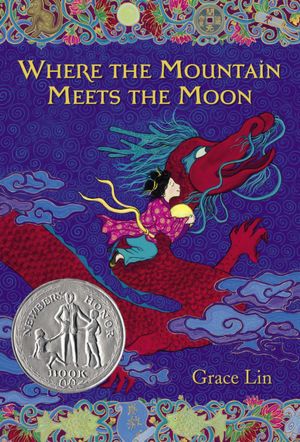
Where the Mountain Meets the Moon 


Where the Mountain Meets the Moon2010 Newbery Honor
NY Times Bestseller (Feb 4th, March 14th 2010)
IndieBound Bestseller
2010 Bank Street College of Education Josette Frank Award
Mythopeic Fantasy Award for Children's Literature
Massachusetts Book Award for Children/Young Adult Literature


Author: Grace Lin
Publisher: Little Brown and Company, copy write 2009
Page Count: 278
Lexile: 820L

Overview: 
"Best known as the award-winning author and illustrator of The Year of the Rat and The Year of the Dog, Grace Lin tries her hand at an original Chinese folktale in her new book Where the Mountain Meets the Moon. All her life, young Minli has lived in the Valley of the Fruitless Mountain, a valley her storytelling father tells her is barren because the mountain above it is the broken heart of the Jade Dragon who longs to be reunited with her children. When her father tells her about the Old Man of the Moon and his ability to answer any question, however, Minli sets out to find the Old Man—using directions given to her by a talking goldfish—to learn how to improve her family's fortunes. As the goldfish's instructions take Minli through the City of Bright Moonlight, the Village of the Moon Rain, and the Never-Ending Mountain, Minli befriends many strange characters, including a trickster king, enlightened children, and a lost dragon, who all tell her stories that make her see the truth in her father's tales, but as Minli gets closer to the Old Man in the Moon, she realizes her experiences have changed her view of her family's fortunes, making her ask a question that will alter the future of the Valley of the Fruitless Mountain in unexpected ways. Drawing inspiration from not only Chinese folktales but also American fairy tales like The Wonderful Wizard of Oz, Grace Lin has crafted a highly accessible and compulsively readable folktale, further enhanced by her beautiful full-color illustrations. Readers who enjoy this tale will be delighted to find that Lin provides a list of books about Chinese folktales that inspired her own story at the end of her Author's Note, helping themexpand their knowledge of stories from other cultures"--Barnes and Noble 


Suggested Delivery: Guided Reading

Words or Phrases to Describe the Book:
1. Chinese Culture
2. Folktales
3. Adventure 
4. Making Sacrifices
5. Having Faith

Electronic Resources:
1. History and Culture of Japan
http://ocw.mit.edu/ans7870/21f/21f.027/home/vis_menu.html
This website has a grid of pictures that are links to explanations of the stories behind each picture.

2. Video of Relaxing Music with Japanese scenes
http://www.youtube.com/user/okanokumo?v=4Xchy6HvY1k
Before students begin reading, they can listen to this music and view the scenery to relax them and prepare them for reading.  

Key Vocabulary: 
1. Coax
2. Fortune
3. Overwhelmed
4.  Despair
5. Drought
6. Famine
7. Anguish
8. Suffering
9. Hesitating
10. Journey

Reading Strategies:
Before:  Much of this story is based in Japanese culture.  By reviewing the electronic resources above before beginning to read, students will be able to have a better understanding of the events and actions in the story.

During: After each chapter, have a discussion regarding the events in the chapter, and the changes in the characters.

After: Have students create a venn diagram to show the differences in Minli before and after her journey.  

Writing Activity:  Minli faces numerous obstacles and challenges during her journey which have a lasting impact on her view of her family and circumstances.  Using the graphic organizer you created to show how she changed during the journey, write a one page response detailing how she has changed, and what made her change.  Use specific examples from the story.

Resources:

Barnes and Noble. (n.d.). In Where the Mountain Meets the Moon. Retrieved September 25, 2012, from http://www.barnesandnoble.com/w/where-the-mountain-meets-the-moon-grace-lin/1100163985?ean=9780316038638

Lin, G. (n.d.). In Awards and Reviews. Retrieved September 25, 2012, from http://www.gracelin.com/content.php?page=wherethemountainmeetsthemoon&display=awards_reviews

Lin, G. (2009). Where the mountain meets the moon. New York: Little, Brown and Co..

Scholastic, . (n.d.). In Where the Mountain Meets the Moon. Retrieved September 25, 2012, from http://www.scholastic.com/teachers/book/where-mountain-meets-moon

Because of Mr. Terupt 


2013 Nutmeg Book Award Nominee 


Author: Rob Buyea
Publisher: Delacorte Books for Young Readers, copy write 2010
Page Count: 288
Lexile: 560L

Overview: 
"It’s the start of fifth grade for seven kids at Snow Hill School. There’s . . . Jessica, the new girl, smart and perceptive, who’s having a hard time fitting in; Alexia, a bully, your friend one second, your enemy the next; Peter, class prankster and troublemaker; Luke, the brain; Danielle, who never stands up for herself; shy Anna, whose home situation makes her an outcast; and Jeffrey, who hates school.  Only Mr. Terupt, their new and energetic teacher, seems to know how to deal with them all. He makes the classroom a fun place, even if he doesn’t let them get away with much . . . until the snowy winter day when an accident changes everything—and everyone. "--Barnes and Noble 


Suggested Delivery: Individual/ Group Reading

Words or Phrases to Describe the Book:
1. Forgiveness
2. Friends and Enemies
3. Everyone has a story
4. Differences in people
5. Having Faith

Electronic Resources:
1. Conversations with the Author
http://www.youtube.com/watch?v=8E_yhjSN_aw
This link is a youtube video of a conversation between Rob Buyea and John Irving regarding the story, characters, and development of the book.

2. Book Bites
http://www.youtube.com/watch?v=iOI3InzleE4
This video introduces students to five different books which they may be interested in reading.  One featured one is Because of Mr. Terupt.

Key Vocabulary: 
1. Coma
2. Concoction 
3. Likelihood
4. Collaborative
5. Ostracized 
6. Overwhelmed

Reading Strategies:
Before: Teachers can introduce the book by asking the students to share about a time they felt they had a teacher who went out of their way to help the students.  This discussion can lead into an introduction of the book.

During: Students should keep a graphic organizer with space for each character in order to fill in details and events regarding each character to help remember them through out the story.

After: This story is full of emotion.  Each student comes from a unique background, the accident brings out sadness, and the ending of the story is lighthearted and full of life.  In small groups, have a teacher led discussion regarding how the sad emotions through out the story help the ending to be such a positive feeling.

Writing Activity:  Imagine you are one of the students in the book.  Write a diary entry regarding your feelings about finding out Mr. Terupt will be your teacher again next year.  Use examples from the book to explain your feelings.     

Resources:

Barnes and Noble, . (n.d.). In Because of Mr. Terupt. Retrieved September 28, 2012, from http://www.barnesandnoble.com/w/because-of-mr-terupt-rob-buyea/1019626278?ean=9780375858246

Buyea, R. (2010). Because of Mr. Terupt. New York: Delacorte Press. 

Nutmeg Book Award, . (2012, June 10). In 2013 Intermediate Nominees. Retrieved September 29, 2012, from http://www.nutmegaward.org/93343/index.html

Story Snoops, . (n.d.). In Book detail. Retrieved September 28, 2012, from http://www.storysnoops.com/detail.php?id=857

Tuesday, September 18, 2012


Kira-Kira 
Kirakira.jpg

ALA Newbery Medal,
ALA Notable Children's Books,
Asian/Pacific American Award for Literature Award Winner
Blue Spruce YA Book Award Nominee (CO)
Booklinks Lasting Connections
Booklist Editors' Choice
California Collections
Capitol Choices List (DC)
CCBC Choices (Cooperative Children's Book Council)
Charlotte Award Suggested Reading List (NY)
Dorothy Canfield Fisher Book Award Master List (VT)
Garden State Teen Book Award Nominee (NJ)
Kiriyama Prize Notable Book
KSRC Middle School Titles - Top Pick
Nene Award Master List (HI)
NYPL "Books for the Teen Age"
Pacific Northwest Young Reader's Choice Award Master List
Thumbs Up! Award Master List (MI)

Author: Cynthia Kadohata
Publisher: Atheneum Books for Young Readers, copy write 2004
Page Count: 244 
Lexile: 740L

Overview: 
"kira-kira (kee ra kee ra): glittering; shining Glittering. That's how Katie Takeshima's sister, Lynn, makes everything seem. The sky is kira-kira because its color is deep but see-through at the same time. The sea is kira-kira for the same reason. And so are people's eyes. When Katie and her family move from a Japanese community in Iowa to the Deep South of Georgia, it's Lynn who explains to her why people stop on the street to stare. And it's Lynn who, with her special way of viewing the world, teaches Katie to look beyond tomorrow. But when Lynn becomes desperately ill, and the whole family begins to fall apart, it is up to Katie to find a way to remind them all that there is always something glittering — kira-kira — in the future.  Chronicles the close friendship between two Japanese-American sisters growing up in rural Georgia during the late 1950s and early 1960s, and the despair when one sister becomes terminally ill."--Barnes and Noble 

Suggested Delivery: Individual Reading

Words or Phrases to Describe the Book:
1. Diversity
2. Historical Fiction
3. Loss and Tragedy 
4. Siblings
5. Reconciliation   

Electronic Resources:
1. History and Culture of Japan
http://ocw.mit.edu/ans7870/21f/21f.027/home/vis_menu.html
This website has a grid of pictures that are links to explanations of the stories behind each picture.

2. Video of Relaxing Music with Japanese scenes
http://www.youtube.com/user/okanokumo?v=4Xchy6HvY1k
Before students begin reading, they can listen to this music and view the scenery to relax them and prepare them for reading.  

Key Vocabulary: 
1. Dismayed
2. Genius
3. Oriental
4. Triumphed 
5. Suspiciously
6. Kimono
7. Constellation
8. Irate
9. Admired
10. Fascinating 

Reading Strategies:
Before:  Before beginning this book, students should have some awareness of Japanese culture.  Using the picture grid in the electronic resources or other books and websites students can familiarize themselves with traditional Japanese ways.   

During: A significant aspect of this book is Lynn's diary.  As students are reading, they should journal their thoughts and feelings about the story.

After: After the students finish their individual reading, they should pair up or get in small groups and discuss the beautiful ending of the story, and how they feel Katie will be able to move on without her sister.

Writing Activity: Imagine that you are Katie, standing next to the ocean in California.  Write a letter to your sister, Lynn, telling her how much you miss her and how the family is doing since her death.    

Resources:

Barnes and Noble. (n.d.). In Kira-Kira. Retrieved September 18, 2012, from http://www.barnesandnoble.com/w/kira-kira-cynthia-kadohata/1100366807?ean=9780689856402 

Kadohata, C. (2004). Kira-kira. New York: Atheneum Books for Young Readers.

Scholastic. (n.d.). In Kira-Kira. Retrieved September 18, 2012, from http://www.scholastic.com/teachers/book/kira-kira

Simon and Schuster, . (n.d.). In Kira-Kira. Retrieved September 18, 2012, from http://books.simonandschuster.com/Kira-Kira/Cynthia-Kadohata/9780689856396

Saturday, September 15, 2012

Sketches from a Spy Tree
Author: Tracie Vaughn Zimmer
Illustrator: Andrew Glass
Publisher: Clarion Books, copy write 2005
Page Count: 64
Age Range: 9-12

Overview: 
" Perched in the branches of her favorite tree with her sketchbook, Anne-Marie watches the world go by. While recording her observations of neighbors, friends, and family, she thinks about her father, who left two years before; about Mike, who seems to be trying to take his place; about her twin sister, Mary Anne, who looks like her (at least to adults) but sees things very differently. Poems in Anne-Marie’s voice, sometimes humorous, sometimes poignant, and always honest, take readers through a year of change in the life of a family and in Anne-Marie’s heart. Illustrations that include paintings, drawings, and collage capture the text’s emotional range and Anne-Marie’s own artistic vision. "--Barnes and Noble 


Suggested Delivery: Small groups

Words or Phrases to Describe the Book:
1. Family Challenges
2. Individuality 
3. Growing up 
4. Free verse
5. Visual Imagery  

Electronic Resources:
1. Poem maker 
http://teacher.scholastic.com/writewit/poetry/poetry_engine.htm
This website has an interactive format to assist students in creating poems of numerous formats.  It has been formatted to work with interactive white boards to be used in a classroom.

2. Video on Twins
This video explains how twins feel about being viewed as one person and other issues brought up in the poems.

Key Vocabulary: 
1. Portrait
2. Landscapes
3. Antique
4. Haunting 
5. Sketchbook
6. Instructor
7Dismantling 

Reading Strategies:
Before:  Since this book is a collection of poems, it is important to be sure that the students have had enough exposure to poems to be able to read fluently.  Using the poem creator above can help familiarize the students with some poetry.  

During: Throughout the book, Annie experiences many emotions regarding her twin, her father, and her mother's new relationship.  Using a timeline, students should track these changes in emotion to see how Annie progresses over time.

After: After the small group have finished reading, the whole class should have a discussion about some of the topics brought up in the text.  Discuss the emotions tracked on the timeline.  How does Annie feel in the end of the book compared to the beginning? 

Writing Activity:   Poetry can be an excellent way to convey emotional topics.  Write three poems to explain your feelings about a particular topic.  For example, you could write a poem about how you felt starting this school year, how you felt in the middle of the school year and one about how you feel now that it is ending.  

Resources:

Barnes and Noble, . (n.d.). In Sketches from a spy tree. Retrieved September 14, 2012, from http://www.barnesandnoble.com/w/sketches-from-a-spy-tree-tracie-vaughn-zimmer/1103789177

Zimmer, T. V., & Glass, A. (2005).Sketches from a spy tree. New York: Clarion Books.

Thursday, September 6, 2012


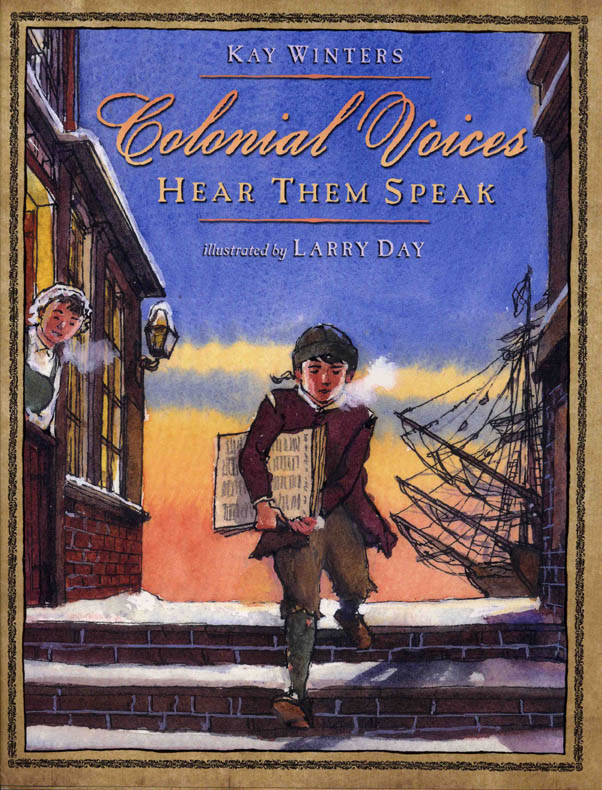
Colonial Voices: Hear them Speak

Virginia Readers Choice List 2011-2012
Children's Book Award List 2010-2011
 
Children's Crown Award 2010-2011
The Charlotte Award 2010
Keystone to Reading Book Award List 2009-2010
Delaware Diamond Book Award List 2009-2010
Nominated for the Cybils Award (2008)

Author: Kay Winters
Illustrator: Larry Day
Publisher: Dutton Children's Books, copy write 2008
Page Count: 40
Lexile Level: 640L

Overview: 
"It's December 16, 1773, and Boston is about to explode! King George has decided to tax the colonists? tea. The Patriots have had enough. Ethan, the printer's errand boy, is running through town to deliver a message about an important meeting. As he stops along his route? at the bakery, the schoolhouse, the tavern, and more-readers learn about the occupations of colonial workers and their differing opinions about living under Britain's rule. This fascinating book is like a field trip to a living history village."--Barnes and Noble 


Suggested Delivery: Individual Reading

Words or Phrases to Describe the Book:
1. Historical
2. Alternate Viewpoints
3. Challenges 
4. Finding One's Place
5. Making a Difference 

Electronic Resources:
1. Picture Gallery 
http://www.boston-tea-party.org/pictures/picture1.html
This website has links to slideshows of various pictures of the Boston Tea Party, as well as timelines and other resources to help explain the events of the Tea Party.

2. Interactive Activity
Students can follow the instructions on this interactive site and explore the events leading up to the Boston Tea Party, and the feelings of those living in the area at the time. 

Key Vocabulary: 
1. Servants
2. Parliament
3. Liberty
4. Apprentice 
5. Patriots
6. Ancestors 
7. Loyalist

Reading Strategies:
Before:  In order to understand this book, students will need to know some of the history and vocabulary of the Boston Tea Party.  The interactive site above can help students learn the difference between the Loyalists and the Patriots, as well as the some of the common terminology.  

During: Each page of this book is a new character.  After each page, students should write down the character, their occupation, and their stance on the tea tax issue in order to assist in remembering all the differing viewpoints.  

After: Using the book as a reference, students should wrote their own definitions for each of the vocab words listed.  They will be able to use the knowledge and understanding they have gained through reading the book and exploring the interactive activity from above.    

Writing Activity:  On the last few pages of the book, there are historical notes which further explain the occupation of each character in the book.  Students should choose one Loyalist character, and one Patriot character, and write a paragraph about each of their views and how they act on these views.  

Resources:

Barnes and Noble, . (n.d.). In Colonial voices: hear them speak. Retrieved September 6, 2012, from http://www.barnesandnoble.com/w/colonial-voices-kay-winters/1111303862

Scholastic, . (n.d.). In Colonial voices: hear them speak. Retrieved September 6, 2012, from http://www.scholastic.com/teachers/book/colonial-voices

Winters, K. (n.d.). In The magic of story. Retrieved September 6, 2012, from http://www.kaywinters.com/Colonial%20Voices.htm

Winters, K., & Day, L. (2008). Colonial voices: hear them speak. New York: Dutton Children's Books.

Monday, August 27, 2012


Henry Aaron's Dream

Author: Matt Tavares
Illustrator: Matt Tavares
Publisher: Candlewick Press, copy write 2010
Page Count: 40
Lexile Level: 920L

Overview: 
"Before he was Hammerin’ Hank, Henry Aaron was a young boy growing up in Mobile, Alabama, with what seemed like a foolhardy dream: to be a big-league baseball player. He didn't have a bat. He didn't have a ball. And there wasn’t a single black ball player in the major leagues. But none of this could stop Henry Aaron. In a captivating biography of Henry Aaron’s young life – from his sandlot days through his time in the Negro Leagues to the day he played his first spring training game for the Braves – Matt Tavares offers an inspiring homage to one of baseball’s all-time greats."--Barnes and Noble 


Suggested Delivery: Read Aloud

Words or Phrases to Describe the Book:
1. Diversity
2. Overcoming Obstacles
3. Segregation 
4. Heroes
5. Achieving Dreams 

Electronic Resources:
1. Fact Monster
http://www.factmonster.com/biography/var/hankaaron.html
Fact Monster is a site with biographies, and interesting facts about people and events.  This link is to the "Hank Aaron" biography, and has links to stats and facts of his time playing baseball.

2. Mini Bio
This is a link to a YouTube video of a mini biography of the life of Henry (Hank) Aaron. 

Key Vocabulary: 
1. Perseverance 
2. Contract
3. Leagues
4. Exhibition
5. Threatening
6. Mesmerized 

Reading Strategies:
Before:   This book has beautiful illustrations that enhance the text.  Before reading, the class should take a picture walk through the book, and analyze the illustrations on each page.  

During: Discrimination is a topic which can be tricky to teach.  Many students will have a wide range of emotional reactions to some of the topics and language in the book.  Encourage students to ask questions, or state how they are feeling, as the book is being read.  

After: Students will understand the underlying concepts in this book more if they can relate it to the "real world."  Show students video clips of Henry Aaron's games, or biographies to give them a connection to the text.   

Writing Activity:  During Henry Aaron's journey to becoming a baseball star, he often thought of his hero, Jackie Robinson.  Imagine you are Henry.  Write a letter to Jackie explaining how you are feeling, and how he has helped you persevere through the challenges.  

Resources:

Barnes and Noble, . (n.d.). In Henry Aaron's dream. Retrieved August 27, 2012, from http://www.barnesandnoble.com/w/henry-aarons-dream-matt-tavares/1014686253

Scholastic, . (n.d.). In Henry Aaron's dream. Retrieved August 27, 2012, from http://www.scholastic.com/teachers/book/henry-aarons-dream

Tavares, M. (2010). Henry Aaron's dream. Somerville, Mass.: Candlewick Press.

Monday, August 13, 2012


Slam Dunk!

Author: Sharon Robinson

Publisher: Scholastic Press, copy write 2007
Page Count: 151
Lexile Level: 600L

Overview: 
"Elijah "Jumper" Breeze is settling into his new home in Harlem--though it hasn't been easy since his father died and his mother moved them from the suburbs.  Still, he made friends at summer camp and he's eager to see them at his new middle school. Jumper is looking forward to hitting the books and hitting the court for some serious b-ball. Then his best friend, Kelvin, talks him into running for student council and suddenly life gets a lot more complicated! He needs to out-poll Nia, his fiercest opponent in the student council race, and doesn't want to lose her friendship in the process.." --Barnes and Noble 


Suggested Delivery: Group Reading

Words or Phrases to Describe the Book:
1. Uplifting
2. Overcoming Obstacles
3. Passion
4. Friendship
5. Responsibility 

Electronic Resources:
1. Basketball Puzzle
http://www.teamopolis.com/play-sports-games-online/default.aspx?GameID=6
This site has a basketball themed puzzle which is timed to add even more fun and pressure to finish!

2. Author Interview
Author Sharon Robinson discuss real life situations she has been in and how they affect her writing.

Key Vocabulary: 
1. Painstaking
2. Unauthorized
3. Privileges
4. Establish
5. Self Evaluate
6. Bribe

Reading Strategies:
Before:   The entire class should participate in a discussion regarding minorities and differences in people.  Discussion should lead students to understanding everyone is equal, regardless of race or social class.  

During: Students should write down any vocabulary they do not understand in each chapter.  At the end of reading time everyday, reading groups should work together to use dictionaries to look up the definitions of the words.

After: In reading groups, discuss how having a mutual interest (in this case basketball) can bring people together and help them get along. 

Writing Activity:  Making speeches can be nerve wracking for many people.  Imagine you are running for student council.  Write a three minute speech informing classmates of the ways you would help your school.

Resources:

Barnes and Noble, . (n.d.). In Slam dunk!. Retrieved August 13, 2012, from http://www.barnesandnoble.com/w/slam-dunk-sharon-robinson/1105865252

Robinson, S. (2007). Slam dunk!. New York: Scholastic Press.

Scholastic, . (n.d.). In Slam dunk!. Retrieved August 13, 2012, from http://www.scholastic.com/teachers/book/slam-dunk-1

Friday, August 10, 2012


To Dance
A Ballerina's Graphic Novel

Author: Siena Cherson Siegel
Illustrator: Mark Siegel

Publisher: Alladin Paperbacks, copy write 2006
Page Count: 64
Lexile Level: 610GN

Overview: 
"Dancers are young when they first dream of dance. Siena was six — and her dreams kept skipping and leaping, circling and spinning, from airy runs along a beach near her home in Puerto Rico, to dance class in Boston, to her debut performance on stage with the New York City Ballet." --Barnes and Noble 


Suggested Delivery: Individual Reading

Words or Phrases to Describe the Book:
1. Engaging
2. Unique Presentation
3. Family Stresses
4. Passion  
5. Coming of Age

Electronic Resources:
1. Historical Comics
http://digitalcomicmuseum.com/
This website has historical comics dating from the early 1900's to the late 1990's. 

2. Author Interview
This site has an interview conducted with Siena Cherson Siegel.

Key Vocabulary: 
1. Performance
2. Audition
3. Barre
4. Choreograph
5. Rehearsal
6. Rhythm 

Reading Strategies:
Before:   Many students will be unfamiliar with the set up of a graphic novel.  It is important to skim the book, discuss the importance of the illustrations, and possibly read a short one or two page comic to show the students how to read a graphic novel.  

During: This book is an emotional ride.  After reading each chapter of the book, students should write a paragraph explaining how Siena felt in regards to the events happening in her life. 

After: Students can illustrate an important event in their lives, using the book as an example.  

Writing Activity:  Students should write a page long essay explaining why they feel the author chose to share her story in graphic novel form, instead of a traditional novel, and how that choice helped to show the feelings in the story.

Resources:

Barnes and Noble, . (n.d.). In To dance: a memior. Retrieved August 10, 2012, from http://www.barnesandnoble.com/w/to-dance-siena-cherson-siegel/1007885000?ean=9781416926870

Scholastic, . (n.d.). In To dance: a memior. Retrieved August 10, 2012, from http://www.scholastic.com/teachers/book/out-dust

Siegel, S. C., & Siegel, M. (2006). To dance: a memoir. New York: Atheneum Books for Young Readers.